PASS A FUNDED CHALLENGE
WITH RULES YOU CAN ACTUALLY SEE.
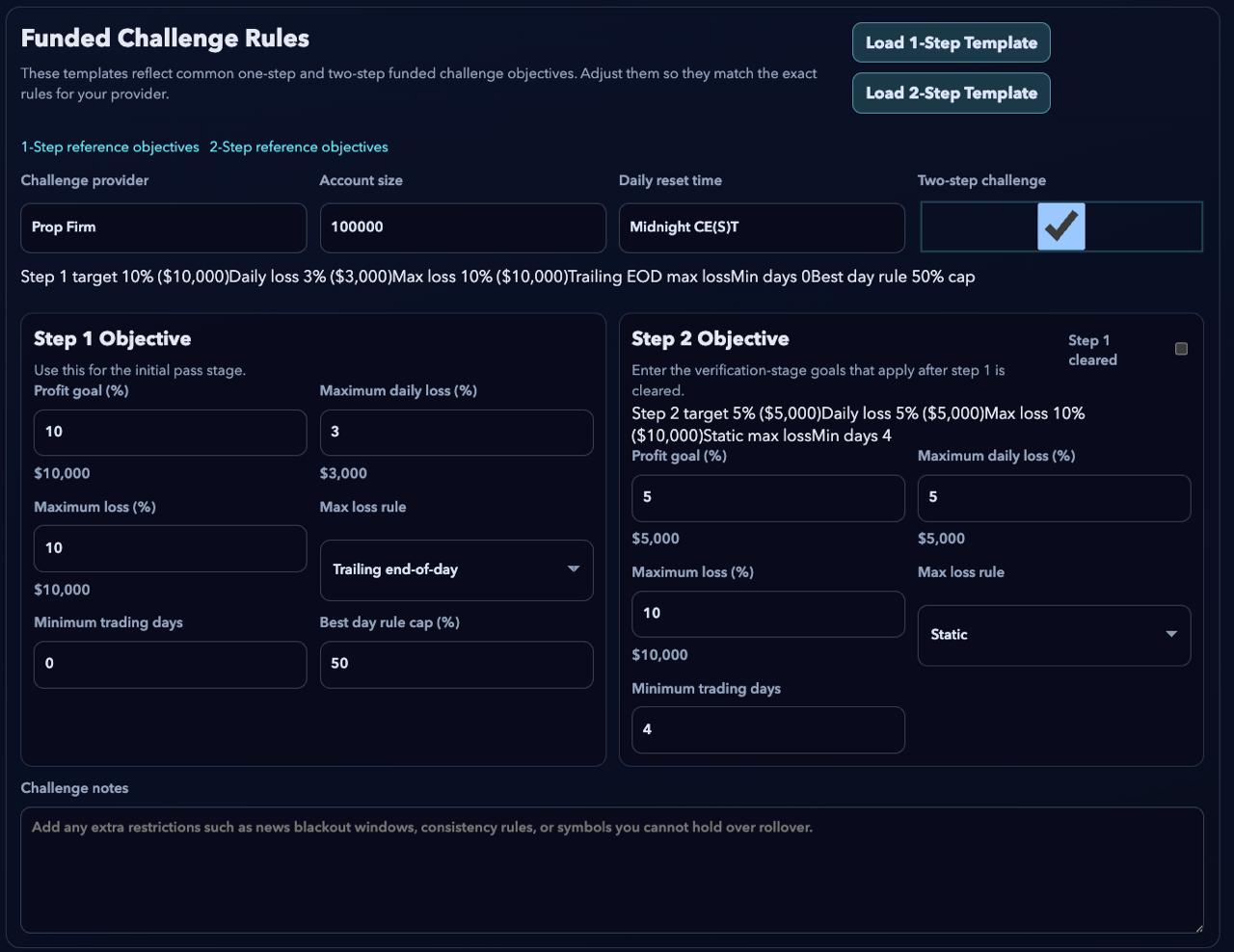
TradeRefinery turns funded challenge rules into visible operating constraints inside Strategy. Load 1-step or 2-step templates, set daily reset times, max-loss models, best-day caps, and challenge notes so the rules stay in front of you while you trade.
TradeRefinery helps you monitor challenge rules, reduce rule slip, and review drift after each session. It does not guarantee results and is not affiliated with any prop firm.
THE RULES ARE EASY TO READ.
HARDER TO HOLD.
Most challenge failures are not one giant mistake. They are a stack of small misses: the reset time you forgot, the loss model you remembered wrong, the challenge note you stopped checking after day two.
MIDNIGHT CHANGES COUNT.
When your daily reset time lives in a provider PDF, you stop seeing it. TradeRefinery keeps it inside the strategy itself so every session starts from the actual rule set, not memory.
STATIC, TRAILING, OR END-OF-DAY MATTERS.
The same account size can still have very different failure math. The new rules layer lets you define the loss model directly, so the challenge structure is visible before drift turns into a breach.
THE SMALL PRINT IS WHERE MOST TRADERS SLIP.
News blackouts, rollover restrictions, best-day caps, minimum trading days, and custom provider notes now sit in one operating layer instead of scattered across screenshots and tabs.
ONE RULE ENGINE.
TWO PHASES. ZERO GUESSWORK.
The new funded challenge module translates provider rules into structured fields your trading process can actually use. Set the challenge once. Keep the constraints visible. Debrief against the same standard after the session ends.
Keep the core structure of the evaluation visible where the trading plan already lives.
Separate profit targets, daily loss limits, max loss rules, and minimum day requirements without bouncing between tabs.
Map the actual failure condition instead of mentally translating provider language every session.
Track the challenge structure that usually gets lost once the first green day hits.
Add the provider-specific edge cases that are easy to forget and expensive to violate.
The challenge structure becomes part of the same discipline system you use to review every session.
HOW IT HELPS YOU PASS.
Not by promising a payout. By tightening the operational layer around the challenge so preventable rule slip becomes much harder.
LOAD THE EXACT RULES.
Choose a 1-step or 2-step template, enter the provider details, and define the real limits that matter for the evaluation you are trading.
KEEP THE STRUCTURE VISIBLE.
Instead of relying on memory, screenshots, or provider dashboards, the challenge logic sits inside your strategy workflow where decisions actually happen.
DEBRIEF THE DRIFT FAST.
After the session, TradeRefinery can score adherence, surface behavioral drift, and keep the challenge constraints tied to your actual execution record.
STOP FAILING FROM RULE SLIP.
TradeRefinery keeps your challenge structure, your strategy, and your session review in the same operating layer so the rules stay visible before drift turns expensive.
TradeRefinery supports rule tracking, discipline infrastructure, and post-session review. Trading outcomes still depend on market conditions, execution quality, and the provider's live rules.